Solana's Crossroads: Navigating Network Congestion, Firedancer, and the Quest for Institutional Adoption
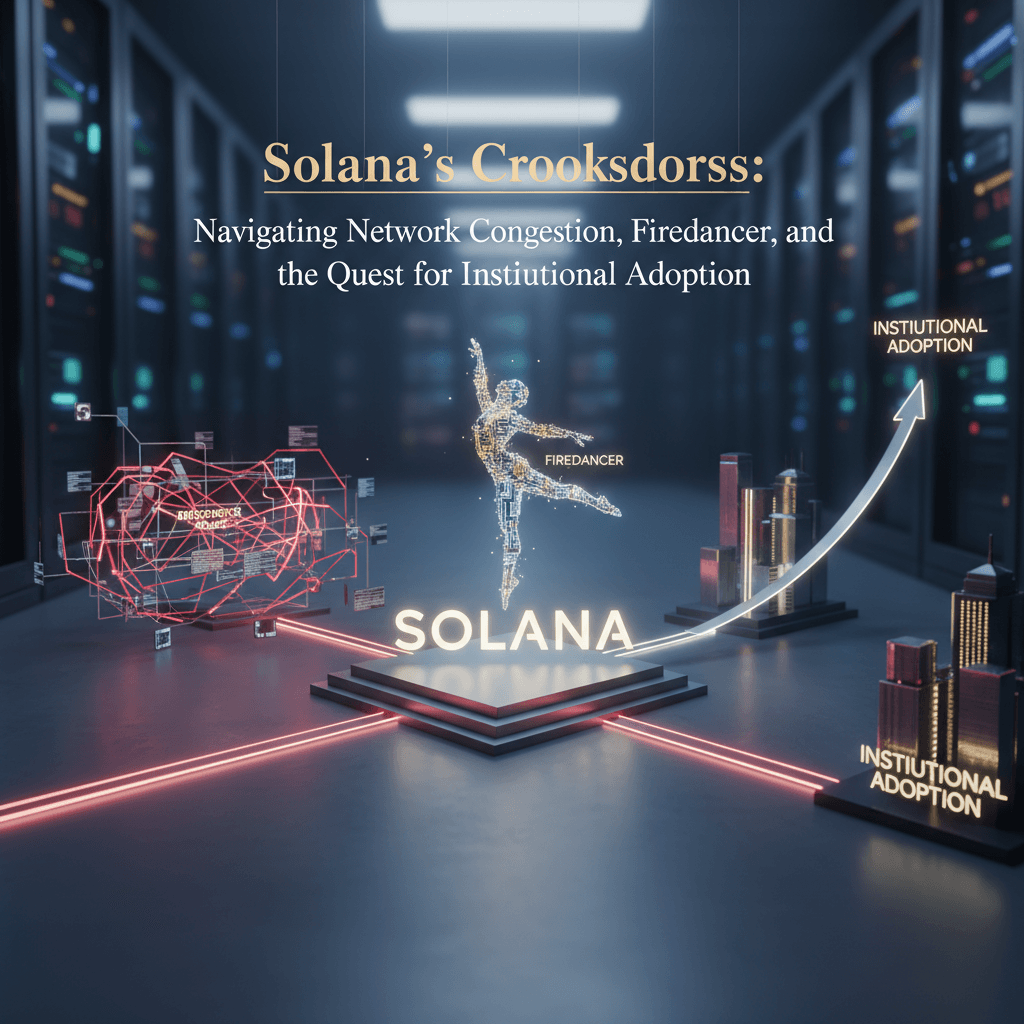
Solana, once hailed as a potential "Ethereum killer" due to its theoretically high throughput and low transaction costs, finds itself at a critical juncture. Ongoing network congestion issues, exacerbated by memecoin mania and arbitrage bots, are testing the limits of its architecture and raising serious questions about its suitability for institutional-grade applications. While the highly anticipated Firedancer validator client offers a glimmer of hope for enhanced scalability and resilience, significant challenges remain in achieving true network stability and attracting substantial, long-term capital from larger financial institutions.
Technical Overview: Decoding Solana's Bottlenecks
Solana's architecture differs significantly from Ethereum's. Ethereum employs a Proof-of-Stake (PoS) consensus mechanism combined with a virtual machine environment that executes smart contracts sequentially. Solana, on the other hand, leverages a Proof-of-History (PoH) mechanism to timestamp transactions, allowing for block production at a much faster rate. This design, while theoretically capable of supporting thousands of transactions per second (TPS), has proven vulnerable to congestion due to several factors, including:
- Transaction Spam: Low transaction costs incentivize malicious actors and bots to flood the network with micro-transactions, overwhelming the system's capacity.
- Hardware Requirements: Solana's high throughput demands specialized, high-performance hardware for validators. This creates a barrier to entry for smaller validators and concentrates network control among a smaller, more centralized group.
- Gossip Protocol Vulnerabilities: Solana's gossip protocol, used for propagating transaction information across the network, can become a bottleneck when the network is under heavy load, leading to delays and transaction failures.
- Localized Congestion: Specific programs or decentralized applications (dApps) can become overly popular, creating localized hotspots of congestion that negatively impact overall network performance, even if the rest of the network is operating normally. This is frequently seen during initial DEX offerings (IDOs) or the launch of hyped memecoins.
The recent spikes in transaction failures and delayed confirmations are not merely technical glitches; they represent a fundamental challenge to Solana's value proposition. Institutional investors require reliability and predictability. Sporadic performance is a non-starter for businesses that depend on the blockchain for critical operations.
Firedancer: A Potential Catalyst for Scalability
The introduction of Firedancer, an independent validator client developed by Jump Crypto, represents a substantial effort to address Solana's scaling limitations. Currently, Solana relies primarily on a single validator client developed by Solana Labs. Firedancer introduces much-needed client diversity. Client diversity enhances the network's resilience to bugs or vulnerabilities in the primary client. The underlying philosophy is similar to redundant systems employed in aerospace or nuclear reactors: multiple independent systems mitigate the risk of catastrophic failure from a single point of weakness.
Firedancer is engineered to improve transaction processing speed and efficiency significantly. Its modular architecture allows for optimizations that are not possible within the existing Solana Labs client. Jump Crypto has invested considerable resources in optimizing Firedancer for the unique demands of the Solana network. Early testing has shown promising results, with Firedancer demonstrating the potential to dramatically increase TPS and reduce latency. However, Firedancer is still relatively new and requires thorough testing and integration before it can fully realize its potential within the Solana ecosystem.
Institutional Sentiment: A Cautious Approach
Institutional interest in Solana is undeniable. The promise of fast, low-cost transactions has attracted attention from hedge funds, venture capital firms, and even some traditional financial institutions. However, the persistent network instability has tempered enthusiasm. These firms are conducting rigorous due diligence, scrutinizing Solana's technical vulnerabilities and assessing the long-term viability of its scalability solutions. Most institutional players are taking a "wait and see" approach, closely monitoring the performance of Firedancer and the overall health of the Solana network.
From an institutional perspective, the key concerns are predictability and security. Fund managers responsible for large pools of capital are reluctant to deploy funds on a platform that is prone to unpredictable outages or subject to manipulation. They want to see consistent uptime, reliable transaction execution, and robust security measures to protect against potential exploits or attacks. Right now, Solana falls short of meeting these stringent requirements.
Protocol Plumbing: Uncorking Solana's Throughput
Beyond Firedancer, several other initiatives are underway to improve Solana's network performance. These include:
- Quality of Service (QoS) Enhancements: Implementing QoS mechanisms to prioritize critical transactions and prevent spam attacks from overwhelming the network.
- State Compression: Reducing the amount of data that needs to be stored on-chain, thereby reducing storage costs and improving transaction processing speed.
- Fee Markets: Introducing more dynamic fee structures to incentivize validators to prioritize transactions based on their economic value. However, this runs counter to claims that Solana should be a low-cost chain, and would make it less attractive to retail users.
- Improvements to the Gossip Protocol: Optimizing the gossip protocol to improve the efficiency of transaction propagation and reduce network congestion.
These technical upgrades are essential. However, they also introduce new complexities and trade-offs. Changes to the consensus mechanism or the fee structure can have unintended consequences. Careful planning and rigorous testing are critical to ensure that these changes improve network performance without compromising security or decentralization.
Trade-offs and Counter-Arguments
It's important to acknowledge the inherent trade-offs in blockchain design. Achieving high throughput often comes at the expense of decentralization or security. Solana has prioritized speed and low transaction costs, but this has arguably led to compromises in network stability and validator diversity. Critics contend that Solana is more centralized than other Layer 1 blockchains, with a relatively small number of validators controlling a significant portion of the network's stake. This centralization raises concerns about censorship resistance and potential collusion.
Solana proponents argue that the network is becoming more decentralized over time as new validators join and as the existing validators become more geographically distributed. They also point to the innovative technologies being developed to address the network's scaling challenges. However, the burden of proof rests on Solana to demonstrate that it can achieve true scalability and resilience without sacrificing decentralization or security.
Data-Driven Evidence: Examining Solana's Performance Metrics
Analyzing key performance indicators (KPIs) provides valuable insights into Solana's health and performance. Metrics to watch include:
- Transaction Success Rate: The percentage of transactions that are successfully processed and confirmed on the network. A low success rate indicates network congestion or other issues.
- Average Transaction Confirmation Time: The time it takes for a transaction to be confirmed. Longer confirmation times increase the risk of transaction failures and create a poor user experience.
- Validator Count and Distribution: The number of active validators and their geographic distribution. A higher validator count and a more diverse geographic distribution improve network decentralization and security.
- Network Uptime: The percentage of time that the network is operational and available. Frequent outages erode trust and confidence in the platform.
The data paints a mixed picture. While Solana has demonstrated periods of high throughput and low transaction costs, it has also experienced frequent periods of congestion and outages. The recent spikes in transaction failures are particularly concerning, highlighting the need for urgent action to address the network's scaling limitations.
Political and Technical Bottlenecks
Addressing Solana's challenges requires not only technical innovation but also effective governance and community coordination. Political disagreements and conflicting priorities among different stakeholders can hinder progress and delay critical upgrades. For example, there may be disagreements about the optimal fee structure or the best approach to addressing network congestion. Reaching a consensus on these issues can be difficult, particularly given the decentralized nature of the Solana ecosystem.
Technically, the implementation of Firedancer and other scaling solutions will require careful integration with the existing Solana codebase. Ensuring compatibility and avoiding unintended consequences will be a significant challenge. Thorough testing and comprehensive auditing are essential to mitigate the risks associated with these upgrades.
Realistic 6-Month Outlook
Over the next six months, the Solana ecosystem will be laser-focused on deploying and optimizing Firedancer as well as other upgrades to enhance performance. The success of these efforts will largely determine Solana's fate. If the network can achieve a sustained period of stability and high performance, it could regain the trust of institutional investors and attract significant new capital. However, if the network continues to experience frequent congestion and outages, its long-term viability will be in serious doubt.
Expect to see increased volatility in the price of SOL as the market reacts to news and developments related to Solana's scaling efforts. Short-term traders may be able to profit from these fluctuations, but long-term investors should exercise caution and carefully assess the risks before committing substantial capital to the platform. The institutional "sideline money" can only wait for so long - if another disruption happens, they will redeploy to other chains.
Frequently Asked Questions (FAQs)
Q1: What is the biggest misconception about Solana?
A1: The biggest misconception is that Solana is inherently "faster" than Ethereum. Solana's theoretical peak throughput is higher, but achieving this consistently in a real-world, adversarial environment has proven challenging. The focus should be on reliable throughput under stress, and that's where Solana has struggled.
Q2: How does Firedancer specifically address Solana's congestion issues?
A2: Firedancer offers multi-faceted improvements. Its highly optimized execution engine can process transactions more efficiently. Its modular design isolates failures, preventing cascading effects. Most significantly, it introduces true client diversity to the validator set, mitigating systemic risks associated with relying on a single software implementation. Diversity of thought goes a long way to preventing black swan events.
Q3: What are the regulatory risks facing Solana?
A3: Like all cryptocurrencies, Solana faces regulatory uncertainty. The SEC could classify SOL as a security, subjecting it to stricter rules. Concerns about DeFi platforms built on Solana, and AML/KYC compliance, are also regulatory pressure points that should be considered.
Q4: What are the key metrics institutional investors are watching to gauge Solana's success?
A4: (1) Transaction Success Rate (TSR): Sustained TSR above 99%. (2) Confirmation Time: Consistently under 1 second. (3) Uptime: Must be near 100%. (4) Validator Set Diversity: Measured by the Nakamoto coefficient. (5) Decentralization: Independent geo-locations, server locations, and client versions.
Q5: If Firedancer fails to solve Solana's scaling problems, what is the most likely alternative path forward?
A5: If Firedancer fails, the most likely path involves a move to something resembling a Layer-2 scaling solution, potentially using zero-knowledge rollups or similar technologies. However, this would represent a significant architectural shift and would likely reduce Solana's unique selling proposition as a "high-performance" Layer 1. Another possibility is a radical re-architecting of the base layer, a technically complex and politically fraught option.