Crypto Regulation's $2 Trillion Tightrope: Navigating Innovation and Systemic Risk
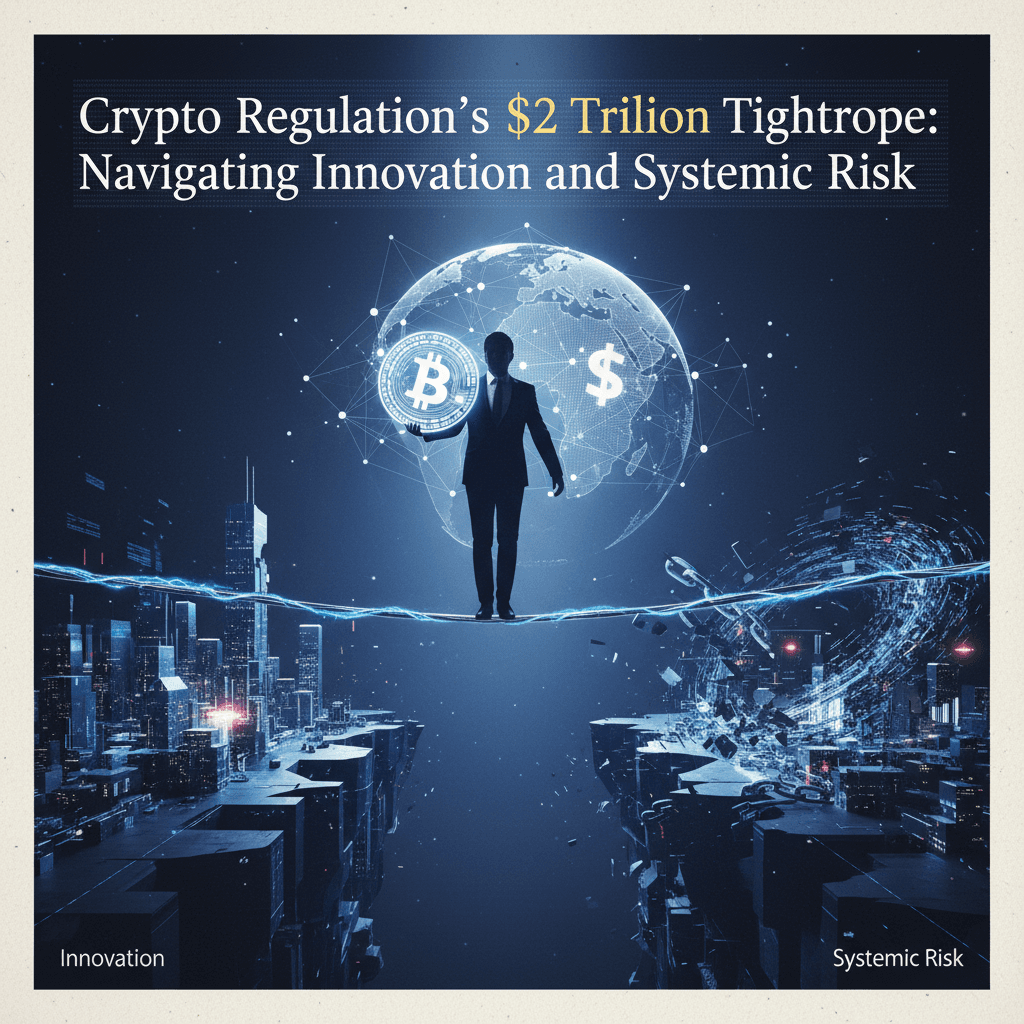
Crypto Regulation's $2 Trillion Tightrope: Navigating Innovation and Systemic Risk
The cryptocurrency market, a volatile beast valued at approximately $2 trillion, stands at a pivotal crossroads. For over a decade, it has largely operated in a regulatory gray zone, fostering innovation and attracting both fervent supporters and skeptical onlookers. However, the rapid growth of decentralized finance (DeFi), the increasing institutional interest in digital assets, and a series of high-profile collapses have forced regulators worldwide to confront the inherent risks and define clear boundaries. This isn't merely about compliance; it's about the very future of crypto and its integration into the traditional financial system. The path forward is fraught with challenges, as policymakers attempt to balance fostering technological advancement with protecting investors and maintaining financial stability. A misstep could stifle innovation, while inaction could expose the system to systemic risk.
Section 1: The Brief (Deep Context)
The story of crypto regulation is a tapestry woven with threads of technological disruption, libertarian ideals, and pragmatic risk management. Bitcoin's emergence in 2008 as a decentralized alternative to traditional finance sparked a global debate about the role of government in controlling money. Early regulatory responses were fragmented and inconsistent, ranging from outright bans to cautious acceptance. China, for example, has repeatedly cracked down on crypto mining and trading, effectively pushing the industry underground. Meanwhile, countries like Switzerland and Singapore adopted a more accommodating approach, aiming to attract crypto businesses and establish themselves as hubs for innovation.
The initial focus was primarily on anti-money laundering (AML) and combating the financing of terrorism (CFT). As crypto exchanges gained popularity, regulators began to impose KYC (Know Your Customer) requirements, forcing them to verify the identities of their users. This move, while necessary to prevent illicit activities, clashed with the pseudonymous nature of many cryptocurrencies, creating friction for users and businesses alike. Then came the rise of ICOs (Initial Coin Offerings) in 2017 and 2018, which saw companies raise billions of dollars by selling digital tokens. Many of these ICOs were rife with scams and unregistered securities offerings, prompting regulators like the SEC (Securities and Exchange Commission) in the United States to step in and assert their jurisdiction.
The subsequent explosion of DeFi, with its complex protocols and tokenomics, presented an entirely new challenge. DeFi platforms operate without intermediaries, using smart contracts to automate financial services like lending, borrowing, and trading. This decentralization makes it difficult to regulate, as there is no single entity to hold accountable. The lack of transparency and the prevalence of unaudited code also make DeFi platforms vulnerable to hacks and exploits, putting users' funds at risk. The collapse of Terra/Luna in May 2022 served as a stark reminder of the potential for systemic risk in the crypto ecosystem, accelerating the pressure on regulators to act decisively.
Section 2: Institutional Convergence (The Strategic Shift)
The increasing participation of institutional investors in the crypto market has been a major catalyst for regulatory change. Pension funds, hedge funds, and even some corporations have started allocating capital to digital assets, albeit in a limited capacity. This institutional interest brings with it increased scrutiny from regulators, who are concerned about the potential impact of a crypto market crash on the broader financial system. If a major pension fund, for instance, were to suffer significant losses from a crypto investment, it could jeopardize the retirement savings of millions of people.
This convergence also necessitates a more standardized and comprehensive regulatory framework. Institutions require clarity and certainty before committing large sums of capital. They need to know that their investments are protected by law and that they can rely on established legal processes in case of disputes or fraud. This is why regulators are increasingly focusing on issues like custody, auditing, and accounting for crypto assets. The creation of clear guidelines for these areas would pave the way for greater institutional participation and help to legitimize the crypto market. Furthermore, institutional players are pushing for the development of regulated crypto derivatives, such as futures and options, to facilitate hedging and risk management.
The strategic shift also involves a growing recognition that crypto is not going away. Initial skepticism has given way to a more nuanced understanding of the technology's potential and its role in the future of finance. Rather than trying to ban or suppress crypto, regulators are now exploring ways to integrate it into the existing financial system in a safe and responsible manner. This includes exploring central bank digital currencies (CBDCs), which could potentially offer the benefits of crypto without the risks associated with decentralized assets. The involvement of institutions has, in essence, forced the hand of regulators to treat cryptoassets as a maturing, albeit risky, asset class demanding structured oversight.
Section 3: Targeted Impacts (Granular Sector Analysis)
The impact of new regulations is being felt unevenly across different sectors of the crypto market. Exchanges, for example, are facing increased pressure to comply with AML and KYC regulations. They are also being scrutinized for potential conflicts of interest, such as participating in market making or offering leveraged trading to retail investors. DeFi protocols are facing an existential threat, as regulators grapple with the challenge of applying traditional financial regulations to decentralized systems. Questions about who is responsible for enforcing the rules and how to ensure compliance remain largely unanswered.
Stablecoins, which are pegged to the value of a fiat currency like the US dollar, are also under intense scrutiny. The collapse of TerraUSD (UST) highlighted the risks associated with algorithmic stablecoins, which rely on complex algorithms to maintain their peg. Regulators are now pushing for all stablecoins to be fully backed by reserves of liquid assets, such as cash and government bonds. This would make them safer and more reliable, but it could also reduce their profitability and limit their potential for growth.
The NFT (Non-Fungible Token) market, which exploded in popularity in 2021, is also facing regulatory challenges. Many NFTs are considered securities under existing laws, which means that they must be registered with the SEC. The lack of clarity around this issue has created uncertainty for NFT creators and collectors alike. Furthermore, the NFT market has been plagued by fraud and scams, prompting regulators to take a closer look. The long-term impacts of regulating the highly novel NFT space remains an open question, especially given the creative applications being explored alongside the speculative investments. The core challenge is to determine when an NFT represents a simple collectible versus an unregistered security offering.
Section 4: The Political Horizon (Committees, Lobbying, & Conflict)
The formation of crypto policy is unfolding within a complex political landscape. In the United States, multiple congressional committees are working on legislation to regulate the industry. The House Financial Services Committee, for instance, has held several hearings on crypto regulation, exploring issues like stablecoins, digital asset exchanges, and consumer protection. These discussions often involve intense lobbying efforts from both the crypto industry and traditional financial institutions, each seeking to influence the final outcome. The SEC and the CFTC (Commodity Futures Trading Commission) are also vying for regulatory authority over different aspects of the crypto market, leading to potential conflicts and jurisdictional disputes.
Across the Atlantic, the European Union is moving forward with its Markets in Crypto-Assets (MiCA) regulation, which aims to create a comprehensive legal framework for crypto assets across all 27 member states. MiCA covers a wide range of issues, including stablecoins, crypto service providers, and market abuse. It is expected to come into effect in 2024 and could serve as a model for other jurisdictions around the world. However, the implementation of MiCA is not without its challenges, as it requires coordination among numerous national regulators and may face resistance from some member states.
Globally, international bodies like the Financial Stability Board (FSB) and the International Monetary Fund (IMF) are also working on crypto regulation. They are concerned about the potential for crypto assets to destabilize the global financial system and are calling for coordinated regulatory action across borders. The political horizon is thus a tangled web of competing interests, regulatory turf wars, and international cooperation, making it difficult to predict the final shape of crypto regulation. The ultimate form regulation takes will be deeply shaped by the interplay of lobbying, political priorities, and perceived economic risk.
Section 5: The Road Ahead (Conservative Timeline)
The road ahead for crypto regulation is likely to be long and winding. A conservative timeline suggests that it will take at least another 12-18 months for major jurisdictions like the United States and the European Union to finalize their regulatory frameworks. Even then, the implementation of these regulations will be a gradual process, as regulators need to develop the necessary expertise and infrastructure to enforce them. In the meantime, the crypto market will continue to operate in a state of uncertainty, subject to piecemeal enforcement actions and evolving legal interpretations.
In the near term, we can expect to see increased scrutiny of stablecoins and DeFi protocols. Regulators are likely to focus on ensuring that stablecoins are fully backed by reserves and that DeFi platforms are not used for illicit activities. They may also impose stricter requirements on crypto exchanges, such as increased capital requirements and enhanced cybersecurity measures. The long-term impact of these regulations will depend on how they are designed and implemented. A well-designed regulatory framework could foster innovation and attract institutional investment, while a poorly designed one could stifle growth and drive businesses offshore. A realistic outlook acknowledges that a balance is needed, one that protects consumers and maintains financial stability while allowing the crypto economy to mature, but achieving that equilibrium will require a delicate and considered approach.
For investors, the key is to stay informed and adapt to the evolving regulatory landscape. This means understanding the potential risks and opportunities associated with different crypto assets and being prepared to adjust their portfolios accordingly. It also means paying close attention to regulatory developments and understanding how they might impact the crypto market. Due diligence and a measured approach are paramount in this environment. Smart investors should avoid hype, focus on projects with sound fundamentals, and avoid excessive leverage. The crypto market remains a risky place, but it also offers the potential for significant rewards. Navigating the regulatory complexities will be crucial for unlocking that potential.
Frequently Asked Questions (FAQ):
-
How will increased regulation affect the price of Bitcoin and other cryptocurrencies? Increased regulation can have mixed effects on cryptocurrency prices. Initially, tighter rules might lead to short-term price declines due to uncertainty and reduced speculative activity. However, in the long run, clear and comprehensive regulations could attract institutional investors, increasing demand and potentially driving prices higher. The acceptance would legitimize crypto as an asset class.
-
What is the MiCA regulation, and how does it impact the global crypto market? MiCA (Markets in Crypto-Assets) is a proposed European Union regulation that aims to create a harmonized legal framework for crypto assets across all EU member states. MiCA would significantly impact the global crypto market by setting standards for stablecoins, crypto service providers, and market integrity. Its potential as a global model could drive adoption of similar standards in other jurisdictions, promoting market stability and investor protection.
-
What steps can crypto businesses take now to prepare for future regulations? Crypto businesses should prioritize establishing robust compliance programs, including KYC/AML procedures, secure custody solutions, and transparent operational practices. Engaging with regulators and participating in industry discussions can also help businesses stay ahead of regulatory changes and adapt their operations proactively. They must assume that future regulations will require greater transparency and accountability.
-
Will DeFi (Decentralized Finance) protocols be able to operate under the new regulatory frameworks? The ability of DeFi protocols to operate under new regulatory frameworks is a significant challenge. Regulators are grappling with how to apply traditional financial regulations to decentralized systems. DeFi protocols may need to incorporate mechanisms for compliance, such as identity verification and transaction monitoring, while preserving their decentralized nature. The future of DeFi will likely depend on innovative regulatory approaches that balance innovation and risk management.
-
Are Central Bank Digital Currencies (CBDCs) a threat to existing cryptocurrencies like Bitcoin? CBDCs and existing cryptocurrencies can coexist, though their roles may differ. CBDCs are digital currencies issued by central banks, offering stability and government backing. Bitcoin and other cryptocurrencies offer decentralization and potential as alternative stores of value or mediums of exchange. While CBDCs may compete with stablecoins and other payment-focused cryptos, Bitcoin's value proposition as a decentralized asset should remain distinct. Each serves different needs and potentially operates in synergistic environments.