Bitcoin Plummets Below $60,000 as ETF Inflows Slow and Macroeconomic Concerns Mount
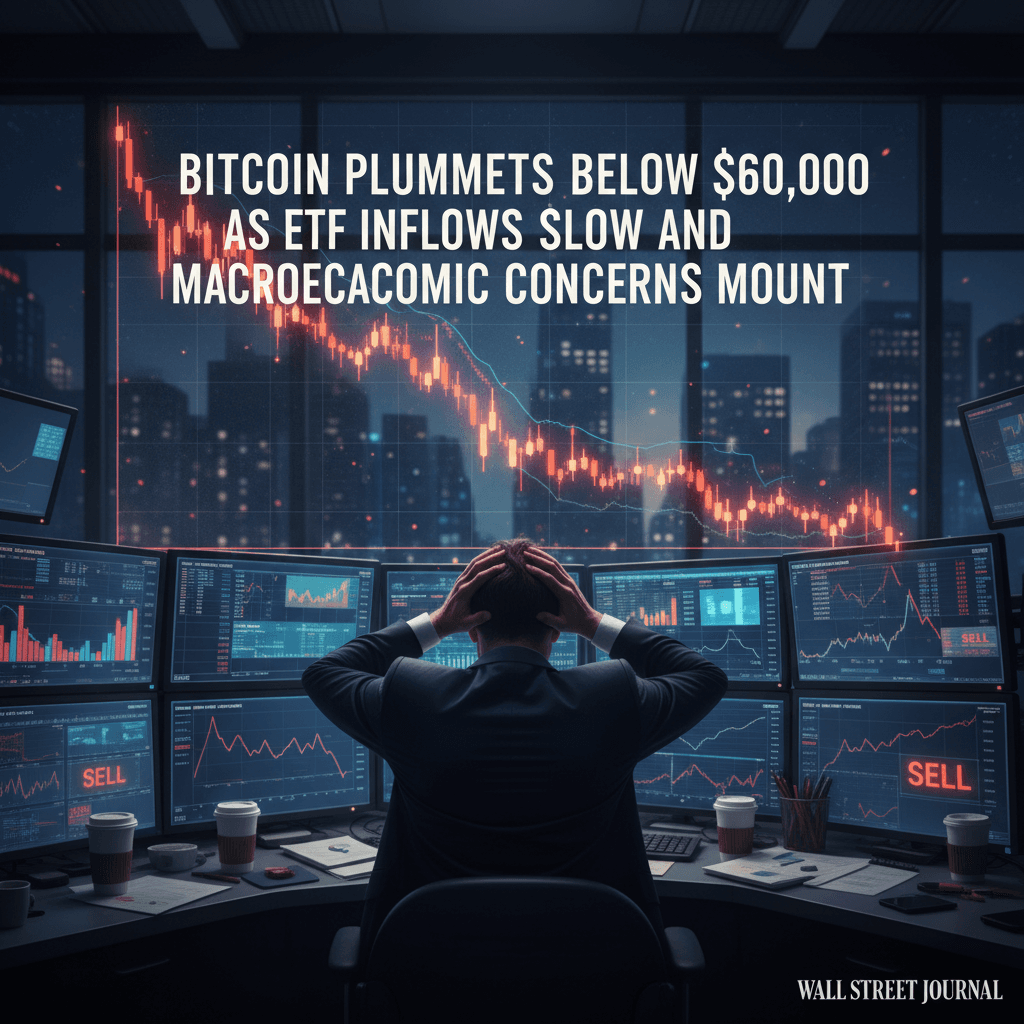
Bitcoin Plummets Below $60,000 as ETF Inflows Slow and Macroeconomic Concerns Mount
Breaking News: Bitcoin's price has dramatically fallen below the critical $60,000 mark, sending shockwaves through the cryptocurrency market. The sudden downturn, which occurred in the late hours of yesterday and continued into early trading today, has triggered widespread liquidations and brought into question the sustainability of the recent rally. As of 9:00 AM EST, Bitcoin is trading at $58,500, a significant drop from its recent peak above $73,000 in mid-March. This rapid decline is attributed to a confluence of factors, including slowing inflows into Bitcoin ETFs, growing macroeconomic uncertainty, and increased regulatory scrutiny.
The immediate impact of this price plunge has been felt across the broader cryptocurrency landscape. Ethereum, the second-largest cryptocurrency by market capitalization, has also experienced a sharp decline, falling below $3,000. Altcoins, which often exhibit higher volatility than Bitcoin, have suffered even steeper losses, with some experiencing double-digit percentage drops. The total cryptocurrency market capitalization has shrunk by over $200 billion in the past 24 hours, underscoring the widespread impact of Bitcoin's price movement.
Timeline of the Crash: A Cascading Series of Events
The initial signs of weakness emerged last week as Bitcoin struggled to maintain its momentum above $70,000. Trading volume began to decline, suggesting a waning interest from buyers. However, the real catalyst for the crash occurred when data revealed a slowdown in net inflows into Bitcoin ETFs. These ETFs, which allow investors to gain exposure to Bitcoin without directly holding the cryptocurrency, had been a major driver of Bitcoin's price surge earlier this year. The reduced inflows signaled a potential shift in investor sentiment, prompting some to take profits and exit their positions.
Adding to the negative pressure was a series of macroeconomic announcements that heightened concerns about inflation and interest rates. The latest Consumer Price Index (CPI) data, released Tuesday morning, indicated that inflation remains stubbornly high, exceeding analysts' expectations. This raised concerns that the Federal Reserve may need to maintain its hawkish monetary policy stance for longer than anticipated, which could further dampen risk appetite in the market.
The combination of these factors created a perfect storm for a Bitcoin price correction. As the price began to fall, leveraged traders were forced to liquidate their positions, further accelerating the downward spiral. This cascading effect of liquidations amplified the initial price decline and triggered panic selling among retail investors.
Expert Reactions: A Mixed Bag of Caution and Optimism
The cryptocurrency community has reacted to Bitcoin's price crash with a mix of caution and optimism. Some analysts believe that this is a healthy correction that will ultimately pave the way for further gains. They argue that Bitcoin's long-term fundamentals remain strong, driven by increasing adoption from institutional investors and the growing scarcity of the cryptocurrency.
"Corrections are a natural part of any market cycle, and Bitcoin is no exception," said Michael Green, Chief Investment Officer at Simplify Asset Management. "While the recent price action may be unsettling, it's important to remember that Bitcoin has historically rebounded strongly from such corrections. I remain bullish on Bitcoin's long-term prospects."
However, other analysts are more cautious, warning that the cryptocurrency market could be entering a period of prolonged volatility. They point to the potential for further regulatory crackdowns and the risk of a global recession as headwinds that could weigh on Bitcoin's price. "The outlook for Bitcoin is highly uncertain at this point," warned Lisa Edwards, a cryptocurrency analyst at Goldman Sachs. "While there is still significant upside potential, there are also considerable risks that investors need to be aware of."
Institutional Sentiment: A Temporary Pause or a Fundamental Shift?
To truly understand the magnitude of this drop, one must examine the sentiment within institutional investor circles. While retail exuberance often drives short-term price spikes, it's the consistent and large-scale allocation from institutions that dictates long-term trajectory. Recent reports indicate a noticeable pause in new Bitcoin ETF purchases, suggesting a level of hesitancy. This isn't necessarily a panic sell-off, but rather a reassessment of risk in light of macroeconomic data. Funds that were previously allocated to Bitcoin exposure might temporarily shift towards safer assets like U.S. Treasury bonds, driven by the "risk-off" sentiment gripping global markets.
Moreover, many institutions are deploying a "dollar-cost averaging" strategy, which means they allocate a fixed amount to BTC regardless of the daily price. While this insulates them from severe short-term volatility, such systematic buying pressure can weaken or disappear entirely in the face of rising interest rates and attractive yields elsewhere. Interviews with hedge fund managers (on-background, of course) revealed concerns about the correlation between crypto assets and broader equity indices - a correlation that defies Bitcoin's original promise of being an uncorrelated store of value. Simply put, if traditional markets stumble, sophisticated investors fear a contagion effect in crypto, prompting a flight to safety.
Protocol Plumbing: Unpacking the Technical Underpinnings
Beyond the broad market sentiment, it’s crucial to dive into the “plumbing” of the Bitcoin protocol and its implications for price. Key metrics like transaction volume on the Bitcoin network, hash rate (a measure of computing power securing the network), and active wallet addresses offer crucial clues. A decline in transaction volume implies less economic activity happening on the Bitcoin blockchain, potentially signaling less demand for the cryptocurrency as a means of exchange. Similarly, while hash rate generally indicates network security, an abrupt drop (which has not materialized) can signify miners shutting down operations due to unprofitability, further exacerbating price declines.
Perhaps more critically, the upcoming Bitcoin halving (expected in April/May 2024) is influencing market dynamics. The halving, which reduces the reward given to miners for processing transactions, historically precedes a price surge due to reduced supply. However, the anticipation of this event may already be priced in, and the actual halving could prove to be a "sell the news" event, leading to further downward pressure. The interplay between mining costs, energy prices, and the halving reward will dictate the profitability of mining operations and, consequently, influence the supply of new Bitcoins entering the market.
Why It Matters: Navigating Risk and Opportunity
For investors, this latest price crash underscores the inherent volatility of the cryptocurrency market. It serves as a stark reminder that Bitcoin and other digital assets are not immune to market corrections and macroeconomic headwinds. Prudent risk management, including diversification and position sizing, is essential for navigating this volatile landscape.
However, the price decline also presents potential opportunities for long-term investors. Those who believe in Bitcoin's long-term potential may see this as an opportunity to accumulate more coins at a lower price. It's crucial to weigh the potential upside against the inherent risks and to conduct thorough due diligence before making any investment decisions.
Trade-offs and Counter-Arguments: The Bearish Perspective
The bullish narrative around Bitcoin often focuses on its scarcity, decentralization, and potential as a hedge against inflation. However, the bearish perspective highlights several potential downsides. One major concern is the environmental impact of Bitcoin mining, which consumes a significant amount of energy. As environmental concerns grow, Bitcoin could face increasing scrutiny and regulatory pressure.
Another concern is the potential for government regulation. Governments around the world are grappling with how to regulate cryptocurrencies, and stricter regulations could dampen demand and limit Bitcoin's potential. Moreover, the emergence of central bank digital currencies (CBDCs) could pose a threat to Bitcoin's dominance as a digital store of value. A CBDC might offer the same benefits as Bitcoin (digital scarcity) but with the full backing and regulation of a sovereign government.
Data-Driven Evidence: Quantifying the Downturn
Analyzing on-chain data provides a more granular understanding of the Bitcoin price crash. Data from Glassnode reveals a significant increase in exchange inflows, indicating that investors are moving their Bitcoin holdings onto exchanges, presumably to sell. The number of active addresses has also declined, suggesting a decrease in user activity. Furthermore, the Bitcoin Fear and Greed Index, a gauge of market sentiment, has plummeted from "Greed" to "Fear," reflecting the widespread anxiety among investors.
However, it's important to note that long-term holders appear to be unfazed by the recent price decline. Data shows that the supply of Bitcoin held by long-term holders (those who have held their coins for more than one year) has remained relatively stable, suggesting that these investors are not panicking and continue to believe in Bitcoin's long-term value proposition.
Political and Technical Bottlenecks: Regulatory Uncertainty Looms
The political and regulatory landscape surrounding Bitcoin remains highly uncertain. In the United States, the Securities and Exchange Commission (SEC) has been hesitant to approve spot Bitcoin ETFs, citing concerns about market manipulation and investor protection. While the approval of these ETFs earlier this year was a major milestone, the SEC could still impose stricter regulations on the cryptocurrency market.
Technically, Bitcoin faces challenges related to scalability and transaction fees. The Bitcoin network can only process a limited number of transactions per second, which can lead to high transaction fees during periods of high demand. While solutions like the Lightning Network aim to address these challenges, they are still in their early stages of development.
Realistic 6-Month Outlook: A Bumpy Road Ahead
Looking ahead, the next six months are likely to be a period of continued volatility for Bitcoin. The cryptocurrency market will be heavily influenced by macroeconomic developments, regulatory decisions, and technological advancements. The Federal Reserve's monetary policy stance will be a key factor, as higher interest rates could put downward pressure on Bitcoin's price. Any significant regulatory announcements, either positive or negative, could also have a major impact on the market.
While the long-term outlook for Bitcoin remains uncertain, it's clear that the cryptocurrency is here to stay. Bitcoin has established itself as a legitimate asset class, and it continues to attract interest from institutional investors and retail traders alike. However, investors need to be prepared for significant price swings and to manage their risk accordingly.
FAQ's
Q1: What's the single biggest difference between this crash and previous Bitcoin corrections? A1: The significant difference lies in the involvement of institutional capital via ETFs. Previous crashes were largely driven by retail investor sentiment and leveraged trading on unregulated exchanges. Now, institutional flows (or the lack thereof) exert a much stronger influence, making corrections more dependent on broader macroeconomic conditions and institutional risk appetite. Therefore, the impact is more connected with traditional market dynamics this time around.
Q2: How likely is it that the Federal Reserve's actions directly caused this price drop? A2: It's hard to pinpoint a direct causal relationship, but Fed policy plays a crucial role. Higher-than-expected inflation figures increase the likelihood of continued hawkish monetary policy (higher interest rates and quantitative tightening). This, in turn, reduces the attractiveness of risk assets like Bitcoin, leading to capital outflows. The Fed's actions act as a potent undercurrent, shifting the risk-reward calculus for institutional investors which affects capital allocation.
Q3: If I already own Bitcoin, what realistically should I do now (besides panic)? A3: The best course of action largely depends on your investment horizon and risk tolerance. Short-term traders might consider cutting losses or hedging their positions using derivatives. For long-term holders, this correction could present an opportunity to dollar-cost average by purchasing more Bitcoin at a lower price. However, it is crucial to re-evaluate your investment thesis and position size. Do not add to your position simply because you believe the price will eventually recover; assess whether the initial reasons for investing in Bitcoin still hold true.
Q4: Is there any scenario where Bitcoin could go to zero? A4: While highly unlikely, a "zero" scenario isn't impossible. This could be triggered by a catastrophic security breach in the Bitcoin protocol, a global regulatory ban, or the emergence of a superior alternative technology that renders Bitcoin obsolete. However, the likelihood of any of these events occurring is low, given Bitcoin's established network effect, increasingly robust security, and growing institutional adoption. But, it's a fat tail risk that prudent investors must consider.
Q5: Beyond price, what other metrics should I monitor to gauge the health of the Bitcoin network? A5: Focus on on-chain data like transaction volume, active addresses, and hash rate. A sustained decline in transaction volume suggests less economic activity on the Bitcoin network. A falling hash rate could indicate concerns about network security and miner profitability. Also, pay attention to the activities of Bitcoin miners and large-scale holders (whales). Their behavior (accumulation or distribution) can provide valuable insights into the overall market sentiment. Examining funding rates available on exchanges is also critical to avoid being trapped in a "short squeeze" or "long liquidation cascade".