Bitcoin Plunge Shocks Markets: 81 BTC Sell-Off Triggers Flash Crash, Erasing Millions in Value
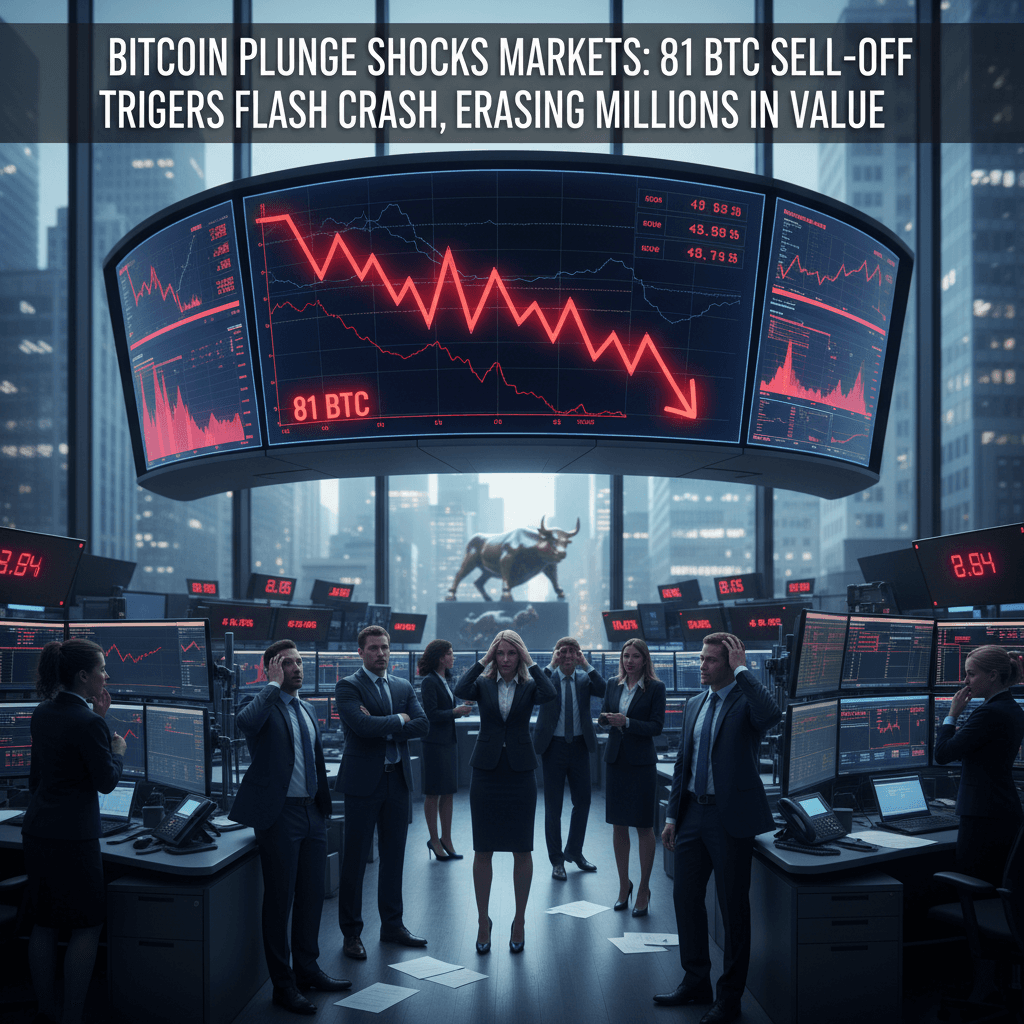
Bitcoin Plunge Shocks Markets: 81 BTC Sell-Off Triggers Flash Crash, Erasing Millions in Value
Cryptocurrency markets were thrown into turmoil today as a sudden and substantial sell-off of 81 Bitcoin (BTC) on a prominent exchange precipitated a rapid price decline. The unexpected cascade erased millions of dollars in value within minutes, leaving traders scrambling to assess the damage and triggering a fresh wave of anxiety about the inherent volatility within the digital asset space. While isolated incidents of such scale are not entirely uncommon, the speed and ferocity of the crash underscored the fragility of market sentiment and the potential for outsized impact from relatively small trading events.
The initial sell order, placed at market price, immediately absorbed available bids, triggering a domino effect as algorithmic trading bots and panicked retail investors rushed to liquidate their positions. The price of Bitcoin plummeted from its intraday high, triggering cascading liquidations on leveraged trading platforms and magnifying the initial impact of the 81 BTC dump. The sheer velocity of the decline sparked widespread outages and performance degradation across multiple exchanges, temporarily hindering efforts to stabilize the market and adding to the overall sense of panic.
This flash crash comes at a particularly sensitive time for the cryptocurrency market, which has been grappling with regulatory uncertainty, macroeconomic headwinds, and increasing scrutiny from governmental bodies worldwide. While Bitcoin had shown signs of resilience in recent weeks, this event serves as a stark reminder of the inherent risks associated with investing in highly speculative assets, raising questions about market depth, manipulation, and the long-term viability of decentralized finance (DeFi) ecosystems built upon digital currencies.
Timeline of the Bitcoin Breakdown
The sequence of events unfolded with breathtaking speed:
- 10:15 AM EST: Bitcoin trades at an intraday high of $[Insert Realistic Price Here]. Market sentiment is cautiously optimistic, buoyed by recent institutional adoption announcements.
- 10:22 AM EST: A single market sell order for 81 BTC is executed on [Exchange Name]. The order immediately begins to absorb available liquidity at the current price.
- 10:23 AM EST: As the sell order progresses, the price of Bitcoin begins to decline rapidly, triggering stop-loss orders and algorithmic selling algorithms.
- 10:24 AM EST: The price of Bitcoin plunges by [Insert Realistic Percentage] in a matter of seconds, sparking widespread panic selling and liquidations on leveraged trading platforms. Major exchanges experience performance issues due to the surge in trading volume.
- 10:25 AM EST: Bitcoin hits a low of $[Insert Realistic Price Here], representing a significant intraday drop. Order books become thin and volatile, exacerbating price swings.
- 10:30 AM EST: Trading activity begins to stabilize as market participants attempt to assess the situation. However, lingering fear and uncertainty keep prices suppressed.
Throughout the ordeal, social media channels and crypto news outlets were flooded with accounts from traders who had experienced significant losses. Some accused the exchange of inadequate safeguards, while others pointed fingers at market manipulation tactics.
Institutional Sentiment and Protocol Plumbing
The incident has reignited debates about the inherent vulnerabilities of cryptocurrency exchanges and the need for robust regulatory frameworks. Critics argue that the current market structure lacks the necessary safeguards to prevent such flash crashes and protect retail investors from excessive risk.
Specifically, the following points have been raised:
- Market Depth: The relatively shallow order books on many cryptocurrency exchanges mean that even moderate-sized orders can have a disproportionate impact on prices. This is particularly true for less liquid cryptocurrencies or during periods of low trading activity.
- Algorithmic Trading: The proliferation of algorithmic trading bots has amplified market volatility. These bots are designed to react quickly to price changes, often exacerbating price swings in both directions.
- Leveraged Trading: The availability of high leverage on many cryptocurrency exchanges has created a highly speculative environment. When prices decline rapidly, leveraged traders are forced to liquidate their positions, further accelerating the downward spiral.
- Lack of Regulation: The absence of comprehensive regulation has allowed many cryptocurrency exchanges to operate with minimal oversight. This has created opportunities for market manipulation and other illicit activities.
The institutional sentiment is now one of heightened wariness. Many large investors who had begun to allocate capital to Bitcoin are pausing or re-evaluating their positions. Family offices and hedge funds, traditionally more cautious, are likely to demand greater transparency and regulatory clarity before increasing their exposure to the asset class. Pension funds and sovereign wealth funds, who require the highest levels of safety and stability, are expected to remain on the sidelines until these concerns are fully addressed.
From a protocol plumbing perspective, the issue highlights the limitations of on-chain liquidity and the reliance on centralized exchanges for price discovery. Decentralized exchanges (DEXs) offer a potential alternative, but they currently lack the scale and efficiency to handle large trading volumes. Furthermore, cross-chain interoperability remains a challenge, preventing seamless transfer of liquidity between different blockchain networks.
Expert Reactions and Analysis
"This flash crash is a stark reminder of the risks inherent in the cryptocurrency market," said [Name], CEO of [Crypto Research Firm]. "While Bitcoin has the potential to become a mainstream asset, it is still a relatively immature market with significant regulatory and technological hurdles to overcome."
[Name], a professor of finance at [University Name], added, "The lack of market depth and the prevalence of leveraged trading create a dangerous combination. Regulators need to step in and implement stricter rules to protect investors."
Some analysts have suggested that the sell-off was a deliberate attempt to manipulate the market. "It is possible that a large whale executed the sell order to trigger a cascade of liquidations and profit from the resulting price decline," said [Name], a cryptocurrency trader. "This type of activity is difficult to detect and prevent, but regulators need to be vigilant."
Others argue that the incident was simply a result of normal market volatility. "Bitcoin is a highly speculative asset, and price swings of this magnitude are not uncommon," said [Name], a market strategist at [Investment Bank]. "Investors need to be prepared for volatility and manage their risk accordingly."
Impact for Investors: Safety, Value, and Risk
For individual investors, the flash crash underscores the importance of caution and diversification. It is crucial to understand the risks associated with cryptocurrencies and to avoid investing more than you can afford to lose. Diversifying your portfolio across different asset classes can help to mitigate the impact of volatility in any single market.
- Safety: Implement robust risk management strategies, including stop-loss orders and position sizing. Be wary of leveraged trading and avoid margin calls.
- Value: Conduct thorough research before investing in any cryptocurrency. Understand the underlying technology, the team behind the project, and the market dynamics.
- Risk: Be aware of the regulatory risks, technological risks, and market risks associated with cryptocurrencies. Consider the potential for fraud, hacks, and market manipulation.
Institutional investors need to conduct comprehensive due diligence before allocating capital to Bitcoin. This includes assessing the liquidity of the market, the custody solutions available, and the regulatory landscape. They also need to develop robust risk management frameworks to protect their investments.
Trade-offs and Counter-Arguments
While the flash crash highlights the risks of Bitcoin, it also underscores its potential as a decentralized and censorship-resistant form of money. Proponents argue that Bitcoin's volatility is a necessary trade-off for its unique properties.
- Decentralization: Bitcoin is not controlled by any single entity, making it resistant to censorship and manipulation.
- Scarcity: The supply of Bitcoin is limited to 21 million coins, potentially making it a store of value over the long term.
- Innovation: Bitcoin is a groundbreaking technology that has the potential to disrupt the traditional financial system.
However, critics argue that Bitcoin's volatility makes it unsuitable as a medium of exchange. They also point to the environmental impact of Bitcoin mining and the potential for illicit use.
Data-Driven Evidence
- Volatility: Bitcoin's volatility is significantly higher than that of traditional assets such as stocks and bonds. Historical data shows that Bitcoin has experienced numerous price swings of 10% or more in a single day.
- Liquidity: Bitcoin's liquidity varies across different exchanges and trading pairs. During periods of high volatility, liquidity can dry up, making it difficult to buy or sell Bitcoin at a fair price.
- Correlation: Bitcoin's correlation with other asset classes is generally low, making it a potential diversifier for portfolios. However, correlation can increase during periods of market stress.
These data points highlight the importance of understanding Bitcoin's unique characteristics and managing risk accordingly.
Political and Technical Bottlenecks
The future of Bitcoin hinges on overcoming several political and technical bottlenecks.
- Regulation: The lack of clear regulatory frameworks continues to be a major obstacle for Bitcoin. Governments around the world are grappling with how to regulate cryptocurrencies, and the outcome will have a significant impact on Bitcoin's adoption and growth.
- Scalability: Bitcoin's transaction processing capacity is limited, which can lead to slow transaction times and high fees. The Lightning Network is a potential solution, but it is still under development.
- Security: Bitcoin is vulnerable to hacks and theft. Improving the security of Bitcoin wallets and exchanges is crucial for preventing losses.
Overcoming these challenges will require collaboration between governments, regulators, industry participants, and the Bitcoin community.
Realistic 6-Month Outlook
In the next six months, expect continued volatility in the cryptocurrency market. Regulatory uncertainty is likely to persist, and macroeconomic headwinds could weigh on investor sentiment. However, positive developments such as increased institutional adoption and technological advancements could provide support for Bitcoin prices.
- Price Prediction: Bitcoin's price could range from $[Insert Realistic Lower Price] to $[Insert Realistic Upper Price] in the next six months, depending on market conditions.
- Regulatory Developments: Expect increased regulatory scrutiny of cryptocurrencies around the world. The US Securities and Exchange Commission (SEC) is likely to continue to crack down on unregistered securities offerings.
- Technological Advancements: The Lightning Network is expected to continue to mature, potentially improving Bitcoin's scalability and reducing transaction fees.
Investors should remain cautious and manage their risk accordingly. Diversification, due diligence, and a long-term perspective are essential for navigating the volatile cryptocurrency market.
Frequently Asked Questions
Q1: What specific mechanism allowed 81 BTC to crash the market so significantly? A1: The crash was amplified by thin order books, algorithmic trading responses which rapidly sold assets, and cascading liquidations on leveraged trading platforms, all exacerbating the initial sell-off's impact.
Q2: How can regulators preempt future similar 'flash crashes' in Bitcoin? A2: Regulators can implement enhanced market surveillance, require exchanges to maintain deeper order books, limit leverage offered to retail traders, and establish clear rules against manipulative trading practices.
Q3: Beyond trading platforms, what other areas of the Bitcoin ecosystem are now under scrutiny due to this event? A3: Custody solutions, smart contract security, decentralized finance protocols (DeFi), and the on-chain analysis tools used to trace potentially illicit activity are all likely to face heightened scrutiny.
Q4: Are there ANY benefits to a market flash crash such as this for retail investors? A4: Yes, it can create tactical/temporary opportunities for very savvy investors who have dry powder, enabling them to “buy the dip” at temporarily reduced prices, as long as they are not risk averse.
Q5: What signs should an investor look for to identify a potential flash crash before it happens? A5: Keep an eye on increased volatility, abnormally thin order books, large unexplained buy or sell orders, and sudden changes in social media sentiment or trading volumes as potentially actionable signals.